Fire retardant impregnation vs paint for wood: Which system to choose?
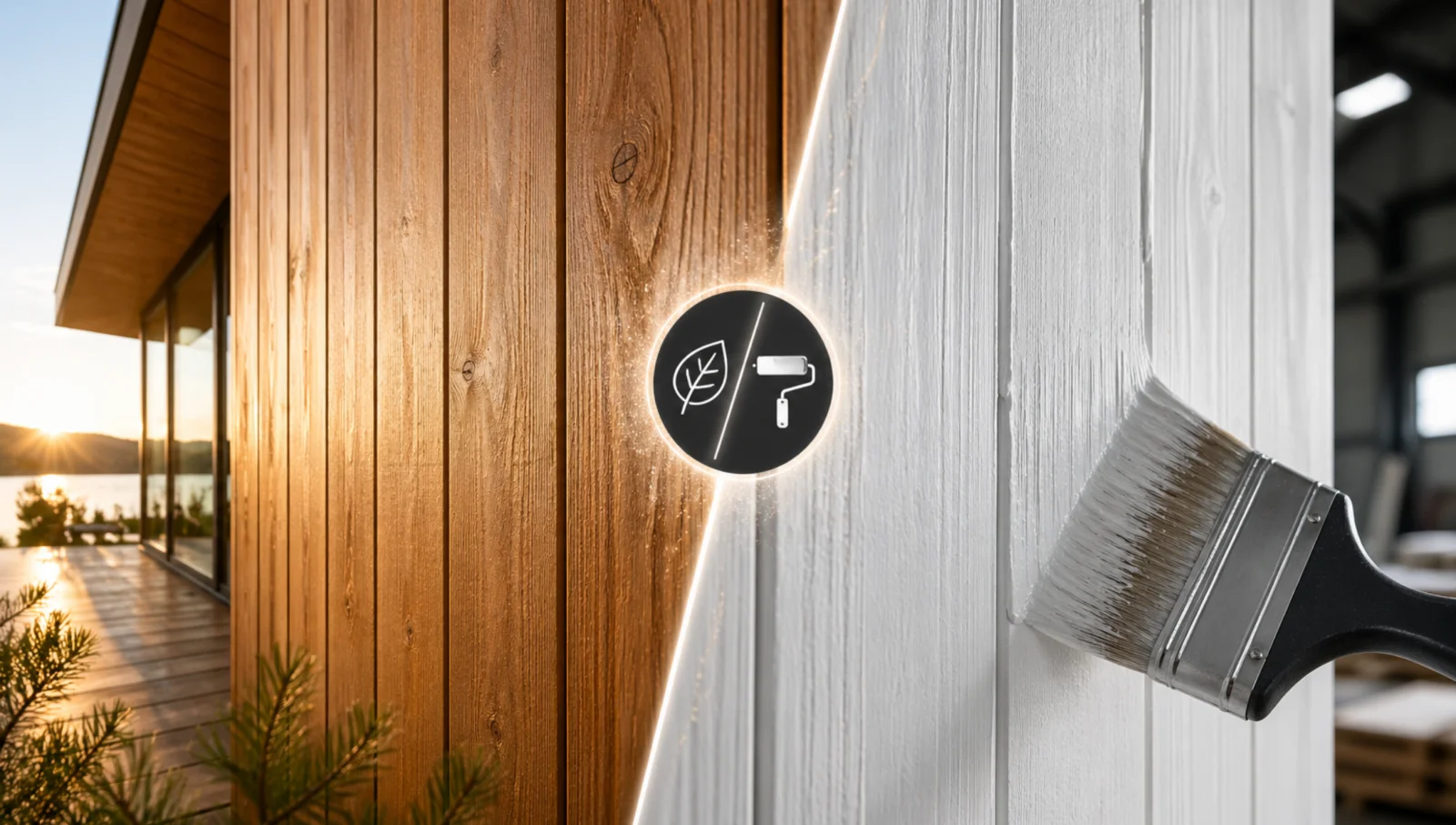
Fire protection of wooden structures is not only about achieving a required fire class. The right solution also depends on the desired appearance, substrate condition, application process, maintenance logic, and exposure environment.
Choose a transparent fire-retardant impregnation when the goal is to preserve the natural appearance of wood and the surface is absorbent. Choose a fire-retardant paint system when the project requires a covered painted finish or when the wood has already been coated, and impregnation can no longer penetrate the surface.
Both systems can have a valid role in fire-safe timber construction. The correct choice depends on the project objective.
What is the difference between an impregnating agent and fire-retardant paint?
A fire-retardant impregnating agent is designed to be absorbed into the wood's structure. Its purpose is to improve the fire behavior of the wood while preserving as much of its natural appearance as possible.
The fire-retardant paint system works as a surface layer. It usually consists of several layers, such as a fire-retardant primer and topcoat. This system covers the wood, resulting in a painted surface.
In simple terms, an impregnating agent is suitable for visible natural wood, and fire-retardant paint is for situations where the wood is supposed to be painted.
SPFR100 vs. fire-retardant paint: key differences
| Criterion | SPFR100 (impregnation) | Fire retardant paint system |
|---|---|---|
| Application method | Penetrates into the wood structure | Surface coating |
| Visual result | Natural wood appearance preserved | Painted surface |
| Reaction-to-fire class achievable | B-s1,d0 (EN 13501-1) | B-s1,d0 possible, depending on the tested system, substrate, and dry film thickness |
| Consumption rate | 220–250 ml/m2, 2 coats | Multi-layer system, varies by product |
| Drying time | 24–48 hours | Multi-stage, varies |
| Maintenance | One maintenance coat 120–140 ml/m² | Full system assessment required |
| Suitable for pre-coated surfaces | Usually requires an absorbent surface | Often suitable, depending on the tested system |
| VOC-free, formaldehyde-free | Yes | Product dependent |
| Certificate | KIWA ET-0388-24, valid until 13.02.2029 | Varies by product |
When to choose SPFR100?
SPFR100 is particularly suitable for projects that aim to combine fire safety with the natural appearance of wood. It is a transparent, water-based impregnating agent designed for a broad range of absorbent wood and wood-based materials, including façades, cladding boards, structural timber, plywood, CLT panels, and other visible timber applications. The required fire classification, substrate, and project documentation should always be matched with the intended use.
A surface treated with SPFR100 retains the wood's natural appearance and does not require an additional finishing layer. This is a significant advantage in architectural solutions where the texture and material sensation of the wood are part of the end result.
SPFR100 is a suitable choice if:
- The goal is to achieve reaction-to-fire class B-s1,d0.
- The wood must remain visually natural.
- The surface is absorbent and is not covered with a pore-sealing lacquer, paint, or oil.
- The solution must be suitable for indoor or outdoor conditions.
- It is important to have a VOC-free, formaldehyde-free, halogen-free, and pH-neutral composition.
- You want to avoid a multi-layered paint system.
The product consumption rate is 220–250 ml/m2. Under normal conditions, the drying time is 24–48 hours. Full fire-retardant performance develops within 5–7 days after treatment.
When to choose a fire-retardant paint system?
Fire-retardant paint may be a sensible choice if the project calls for a painted surface. For example, in technical rooms, industrial buildings, or interior applications, the wood's natural grain pattern is not important.
The paint system may also be more suitable if the base surface is already covered, and the impregnating agent cannot be absorbed further into the wood. SPFR100 is generally not suitable for surfaces that are covered with pore-sealing coatings, such as lacquers, paints, or oils.
A fire-retardant paint system may be a suitable choice if:
- The end result must be a painted surface.
- The wood's natural appearance is not important.
- The base surface is already covered.
- The project requires a specific color tone or covering finish.
- The client has taken into account a multi-layered system and its maintenance.
Work process and maintenance
SPFR100 is applied in at least two coats, with a minimum of 60 minutes between coats. The drying time under normal conditions is 24–48 hours.
Fire-retardant paint systems usually require several interrelated layers. Therefore, in addition to the cost of the material, you need to consider the stages of work, drying times, control of layer thickness, and subsequent maintenance.
SPFR100 maintenance usually requires just one maintenance layer with a quantity of 120–140 ml/m2. If the treated surface gets mechanically damaged, the damaged or cut areas need to be re-treated.
For paint systems, maintenance depends on the condition of the entire system. If the top layer is damaged or peels off, it needs to be assessed whether only the visible paint layer is affected or whether the fire-protective base layer is as well.
Summary
SPFR100 and fire-retardant paints fulfill the same general purpose but are suitable for different situations.
If the goal is to preserve the natural appearance of the wood and, at the same time, achieve reaction-to-fire class B-s1,d0, a transparent impregnating agent like SPFR100 is often a more practical solution. It is well-suited for visible wooden surfaces such as façades, cladding boards, and other absorbent wood-based applications. For CLT panels and other wood-based materials, SPFR100 may be a suitable solution, but the required reaction-to-fire classification, substrate, and project-specific documentation should be confirmed before specification.
If the goal is a covering painted surface or the base surface does not allow impregnation, a fire-retardant paint system may be more suitable.
The right choice always depends on the project: the base surface, fire safety requirements, desired appearance, usage environment, and maintenance logic.
FAQs
Is fire-retardant impregnation better than fire-retardant paint?
It depends on the project. Impregnation is usually better when the natural wood appearance must be preserved. Fire-retardant paint is usually better when a painted finish is required.
Can fire-retardant impregnation replace fire-retardant paint?
Not always. Fire-retardant impregnation is usually preferred when the natural appearance of wood must be preserved, and the surface is absorbent. Fire-retardant paint is usually preferred when a covered painted finish is required or when the wood has already been coated.
Can SPFR100 be used on painted wood?
SPFR100 is designed for absorbent wood surfaces. Existing film-forming coatings, such as paints, lacquers, or oils, can block absorption, so previously coated surfaces should be assessed before treatment. In many cases, the coating must be removed, or a different fire-protection system may be more suitable.
Does SPFR100 preserve the natural look of wood?
Yes. SPFR100 is transparent and is designed to preserve the natural appearance of wood.
Is SPFR100 certified to B-s1,d0?
Yes, under the certified scope defined in the classification report K16/2024 and certificate ET-0388-24. The current certificate ET-0388-24 was first issued on 14 February 2024 and remains valid until 13 February 2029, provided that the technical description, manufacturing conditions and factory production control are not significantly modified.
B-s1,d0 Fire Classification for Wood: EN 13501-1 Test Results Explained
Fire Reaction and Fire Resistance in Building Structures
Want to know whether SPFR100 or a paint system is better suited to your project? Contact us, and we will help you choose a technically suitable solution.
See a full side-by-side comparison: impregnation vs intumescent paint vs pressure treatment →
Related articles
Weather Exposure and Fire-Retardant-Treated Timber
Further resources



 +372 5686 4224
.png "Taavi Küng")
 +372 5695 2333
 taavi@solidprotect.eu
.png "Priit Jänes")
.png "Raido Rokk")